A familiar scenario: a CTO at a startup needs to grow the team by three developers by the end of the quarter. Local hiring takes months, and he hears about outstaffing and outsourcing from every direction, sometimes as if they were the same thing. The decision he makes will determine who manages the work, who is accountable for the schedule, and what happens when something goes wrong.
This article lays out the difference and offers a way to decide.
The Difference in One Line
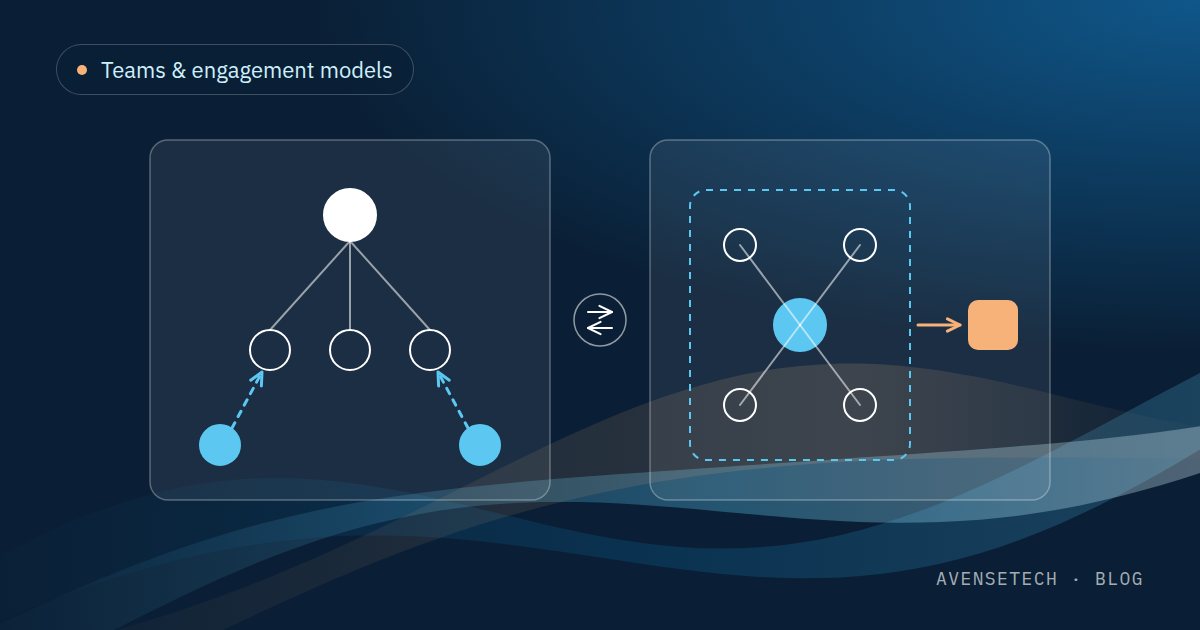
In Outstaffing, the developers join your team and you manage the work: you define tasks, set priorities, run code review, and decide on the architecture. The company that provides them is their employer, and they work for you in practice. You can add a manager from Israel as an extra.
In Outsourcing, you hand us responsibility for the outcome. We recruit the team, manage the requirements, break them into tasks, and manage the work. We commit to timelines according to a work plan.
In short: with Outstaffing you buy manpower and manage it. With Outsourcing we manage the work and commit to the timelines in the work plan.
Four Questions That Decide
You do not need a complex decision matrix. Four questions, answered honestly with someone who knows the team from the inside, are enough in most cases.
1. Do you have someone who can actually manage developers?
Outstaffing works when, on your side, there is at least one technical person with real time to dedicate to the team: to explain, prioritize, and review code. Being "available for questions" is not enough. If the CTO already works sixty hours a week putting out fires, adding developers will not save him time. It will add one more thing to manage.
If there is no one to manage, Outsourcing is the natural choice, or Outstaffing with a manager from Israel as an add-on.
2. How clear is what needs to be built?
When there is an existing product, a live backlog, and a team that knows the direction, it is easy to bring in additional developers. When there is a defined product and requirements, even if they are not fully written yet, someone has to translate them into a plan. Under Outsourcing this is part of the service: a spec, followed by a work plan. When there is only an idea, the fitting track is a Software House.
3. Do you need a schedule commitment or flexibility?
Outstaffing gives flexibility. You can change direction within a week, shift priorities, and add or remove tasks without negotiating scope. The price is that responsibility for the schedule stays with you.
Outsourcing gives a commitment according to the work plan, and the price is that any significant change in scope is a conversation that has to be managed. If you have a date that must hold, this is a heavy consideration.
4. What is the future of the system at your company?
If the system is the core of the company and the in-house development team is a strategic asset, developers who integrate into the team and know the code over time are an asset. If it is a contained project, an internal system, or a module unrelated to the main product, a closed deliverable fits better.
Answer the questions based on what actually happens at the company today, and not what you would like to happen. Anyone who answers "we'll dedicate time to the team" without clearing it on the calendar will meet the problem in week three.
Where Each Model Fails
Even the right choice can fail in execution. It is worth knowing each model's weak points in advance, and deciding who on your side owns them.
Each model has its own risk. Two failures recur:
In Outstaffing: developers receive unclear tasks and wait quietly. When no one prioritizes, the result looks like work but does not move forward. The fix: assign one person on your side who is responsible for their queue, and set a short daily sync.
In Outsourcing: the client disappears after the spec and returns at the testing stage with comments that change direction. A work plan with timelines binds you as well: availability for questions, timely approvals, and feedback at every stage.
A common case: a company chooses Outstaffing because it wants control, and discovers after a few weeks that it has no one to prioritize and review. In that case, moving to Outsourcing, or adding a manager from Israel, puts the work back on track. The reverse direction happens less often, but it exists too: a client that has already built a strong technical team prefers to take the management in-house.
Three Patterns That Recur
Three templates you can recognize from experience:
An in-house team under load. There is a clear backlog, a technical manager, and a resource gap. This is the classic Outstaffing case: the developers enter the existing processes, and the impact is felt within weeks.
A new product with no technical team. There is a business owner with a good business definition but no one to translate it into a technical plan. Here a Software House fits, because we take the product from idea to launch.
An existing system where a module needs to be extended. It depends on who knows the code. If you have a developer who knows it well and lacks capacity, Outstaffing. If no one knows it, have the party managing the project include an understanding and documentation phase.
Software House, Cost, and a Trial Month
A Third Model: Software House
There is a third situation, when you do not have a product yet. In the Software House model we build from scratch: product management, development, design, and marketing. It suits entrepreneurs and businesses that have an idea and a market but no team. If you already know what to build, you do not need it.
How Much It Saves, and How to Test Without Committing
The saving compared with local hiring is between 25% and 40%. The price is a final monthly price per full-time employee, all-inclusive, with no special equipment and without the Israel-based manager service. The developers are employed by us in the Philippines, and working hours are adapted to the client.
The first month is a paid trial month. It is meant to give you exactly what a presentation will not: evidence of the quality of the work, the communication, and the pace, before you decide to continue. Treat it as a real test, with real tasks and criteria you defined in advance.
You can read about managing the team once it starts in the article on a weekly routine for a remote team.
What to Ask Every Vendor, Us and Others
- Who is responsible for the schedule if something slips, and where is that written?
- What does an initial spec look like, and who writes it?
- Who interviews the developers before you receive them, and what is the bar?
- What happens in the first month, and how is it measured?
- Who holds the code, the environments, and the access at the end of the project?
A vendor who struggles to answer questions like these directly will struggle once the project starts.
The bottom line
If you have a technical manager with time and a clear task list, Outstaffing will save you time and money and leave the steering wheel with you. If you have a goal, a date, and less time to manage, Outsourcing hands us responsibility for the road. Deciding by the four questions above takes a few minutes and can prevent an expensive mistake.
If your answers point to managing the team yourself, you can start with Outstaffing.